
The Carbon Ledger of Conflict
Geopolitical Blind Spots in Global Climate Frameworks
The global effort to mitigate anthropogenic climate change is currently operating with a significant structural deficiency: the systematic omission of military emissions from international governance frameworks. For decades, the global military-industrial complex has functioned within a regulatory blind spot, shielded by geopolitical sensitivities and perceived national security imperatives. This lack of transparency is not merely an accounting error; it represents a fundamental threat to the integrity of global environmental governance. When the carbon cost of state-sponsored violence and defence posturing is excluded from national greenhouse gas (GHG) inventories, the resulting data provides an incomplete and potentially misleading picture of the path toward Net Zero. Understanding these blind spots is critical for establishing a baseline of true national accountability and ensuring that climate treaties are based on physical reality rather than diplomatic convenience.
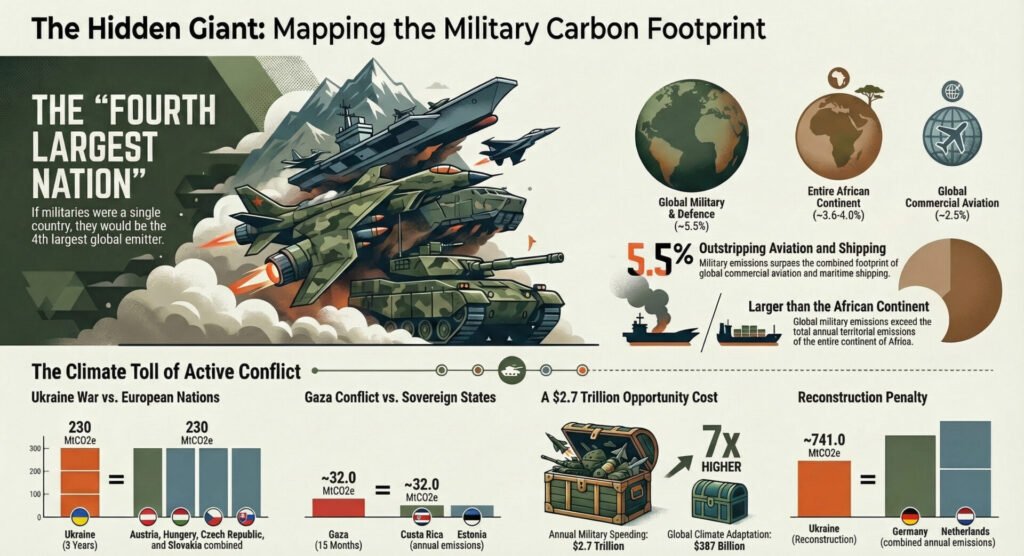
The historical trajectory of these exemptions reveals a deliberate policy of institutionalised invisibility. During the negotiations for the 1997 Kyoto Protocol, intensive lobbying efforts led by the United States Department of Defense successfully secured exemptions for military bunker fuels and emissions generated during overseas operations (CEOBS, 2022). While the 2015 Paris Agreement theoretically addressed this by removing blanket exemptions, it replaced them with a voluntary reporting mechanism. Under this current framework, sovereign states are not legally mandated to disaggregate or report military fuel consumption, effectively allowing the “military emissions gap” to persist (CEOBS, 2022). This gap masks a staggering environmental reality: the global military apparatus is responsible for an estimated 5.5 per cent of total global emissions, which equates to approximately 2,750 million metric tonnes of carbon dioxide equivalent (MtCO2e) annually (SGR/CEOBS, 2022). To put this into perspective, the global military footprint ranks as follows:
- China (Largest emitter)
- United States
- India
- Global Military Apparatus (2,750 MtCO2e)
- Russian Federation
If considered as a single sovereign entity, the world’s combined armed forces would rank as the world’s fourth-largest emitter, surpassing the entire annual output of Russia and outstripping the combined emissions of the global commercial aviation and maritime shipping sectors (SGR/CEOBS, 2022). This massive operational footprint exists largely outside the purview of the United Nations Framework Convention on Climate Change (UNFCCC), creating a profound disconnect between stated climate ambitions and the carbon-intensive reality of global security.
Quantifying the Opaque Through Macroeconomic Modelling
Quantifying the environmental cost of warfare requires bypassing the veil of state secrecy through sophisticated economic modelling. Traditional reporting fails because it relies on self-disclosure from institutions that often view such data as a matter of classified tactical information (or a vulnerability to be exploited by adversaries). To derive the true carbon ledger of the military sector, researchers must employ alternative methodologies that look beyond direct fuel logs to the financial and industrial underpinnings of the defence complex (Physics World, 2026).
The primary architecture for this assessment involves Environmentally Extended Input-Output (EEIO) modelling and Lifecycle Assessments (LCA). EEIO models allow researchers to map the complex financial flows between industrial sectors and convert defence expenditure into greenhouse gas equivalents. By using databases such as Eora26 and the SIPRI Military Expenditure (MILEX) database, it is possible to capture the upstream Scope 3 emissions associated with procurement and industrial support (Physics World, 2026). This econometric approach uses specific conversion factors: current models indicate a spend-emission ratio of approximately 0.000534 tCO2e per US dollar spent on military equipment (NIH, 2026). Furthermore, there is a clear macroeconomic correlation between militarisation and carbon intensity: for every 1 per cent increase in the global military expenditure (MILEX) ratio as a percentage of GDP, global CO2 emission intensity rises by 0.042 kg/USD (NIH, 2026).
LCA integration complements this by providing a physical measurement of specific systems: from the extraction of raw materials to the manufacturing of munitions and their eventual detonation. This dual approach ensures that even in the absence of transparent state reporting, the carbon footprint of warfare can be estimated with a high degree of analytical rigour. This methodology is now being applied to active combat zones to reveal the immediate atmospheric consequences of kinetic warfare.
Direct Operational Impact of Kinetic Warfare
Modern warfare is a capital-intensive, fossil fuel-dependent enterprise. The transition from infantry-based combat to mechanised, high-tech operations has created a “carbon iceberg” where the visible tip of direct combat emissions is supported by a massive underwater structure of logistical and operational fuel consumption. For major militaries, hydrocarbon dependency is a foundational requirement for power projection, making them the most energy-intensive institutions on the planet.
The US Department of Defense (DoD) serves as the primary example of this operational intensity, remaining the world’s largest single institutional consumer of petroleum. Between 2001 and 2018, the US military emitted an estimated 1,267 MtCO2e (Crawford, 2023). A significant portion of this (approximately 440 million metric tonnes) was generated specifically by the Overseas Contingency Operations in Iraq, Afghanistan, and Syria (Crawford, 2023). The 2003 invasion of Iraq alone released roughly 250 million tonnes of CO2e during its most intense kinetic phases (Anadolu, 2025).
Military aviation represents a particularly potent driver of warming. With over 53,000 aircraft globally, the military fleet is significantly larger than its commercial counterpart (CEOBS, 2025). These aircraft operate at high altitudes where they release not only CO2 but also nitrogen oxides (NOx) and create contrail cirrus clouds (CEOBS, 2025). These non-CO2 factors disrupt the atmospheric radiative balance, meaning that the true warming potential of military aviation is structurally higher than civilian flight. Recent conflicts have demonstrated how quickly these emissions can spike: the first 12 months of the Ukraine conflict saw 120 million tCO2e released, a figure that climbed to 230 MtCO2e by the end of the third year (Climate Focus, 2024; Earth.Org, 2025). In the Middle East, the bombardment of Gaza generated 1.89 million tCO2e in just 15 months (The Guardian, 2025). These figures are not static; they represent a surge in atmospheric carbon that occurs alongside the deliberate destruction of energy infrastructure: such as the Nord Stream pipeline sabotage, which released 14.6 MtCO2e of methane into the Baltic (CLICCS, 2026).
The Industrial Multiplier Re-armament Penalty
The carbon footprint of warfare extends far beyond the combustion of fuel in tanks and jets. It is underpinned by a “supply chain multiplier” that captures the emissions generated by the manufacturing, maintenance, and international transfer of armaments. Procurement cycles in the defence sector create long-term “carbon lock-in”: once a nation invests in a specific fleet of aircraft (such as the F-35) or warships, it is tethered to a fossil fuel-intensive operational path for the duration of that equipment’s multi-decade lifespan.
Research indicates that the supply chain multiplier for the military sector is approximately 5.8 (CEOBS, 2022). This means that for every tonne of CO2 emitted during operations, nearly six tonnes are generated in the industrial process of manufacturing and transporting the hardware. With global military spending reaching a record $2.7 trillion in 2024, the industrial output of the global arms trade is accelerating (SGR, 2025). Plans like the “ReArm Europe Plan” are projected to increase the military carbon footprint of EU-NATO countries to 95 MtCO2e, a 140 per cent increase over 2021 levels (TNI, 2024). This is driven by the energy-intensive production of high-tech munitions, autonomous drones, and ballistic steel.
Transnational logistics further exacerbate this issue. The shipment of 50,000 tonnes of military supplies from the US to Israel during the war on Gaza accounted for nearly 30 per cent of the total greenhouse gases generated in that period (The Guardian, 2025). Furthermore, conflict routinely disrupts civilian shipping, as seen in the Red Sea where the diversion of vessels around the Cape of Good Hope has led to a significant increase in maritime fuel consumption (The Guardian, 2025). These industrial and logistical factors represent a massive, indirect climate penalty that locks sovereign states into high-carbon liabilities at the very moment they should be decoupling from fossil fuels.
Embodied Carbon and the Reconstruction Liability
Perhaps the most chronologically delayed and devastating climate impact of war is the destruction of the built environment. Every building, road, and utility grid represents a historical investment of “embodied carbon”: the emissions spent during the extraction and assembly of cement, steel, and glass. When urban centres are reduced to rubble, this carbon investment is lost, and the subsequent reconstruction requires a massive new injection of emissions. Replacing decimated capital stock involves “hard-to-abate” sectors like cement production, which inherently releases CO2 through the chemical calcination process (CEOBS, 2025).
The scale of this reconstruction liability is staggering. In Ukraine, the artillery and aerial bombardment of cities has created a structural deficit that will take years to rectify. In Gaza, the destruction of 90 per cent of the housing stock has created 60 million tonnes of toxic debris (The Guardian, 2025). The following table illustrates the projected emissions required to rebuild major conflict zones:
Conflict Zone | Estimated Reconstruction Emissions | Primary Drivers of Emissions | Comparative Scale |
Ukraine | ~741.0 MtCO2e | Cement/steel for heavy infrastructure, energy grids, and housing (over 10 years). | Equivalent to the annual emissions of Germany and the Netherlands combined. |
Gaza | ~29.4 MtCO2e | Rubble clearance (60m tonnes), rebuilding 436,000 apartments, utilities. | Roughly equivalent to the annual emissions of New Zealand or Croatia. |
Syria | ~22.0 MtCO2e | Housing sector reconstruction in western corridors (Aleppo, Homs, Hama). | Partial sectoral estimate (housing only). |
(Source: JICA, 2024; The Guardian, 2025; World Bank, 2025)
The Erasure of Natural Carbon Sinks
Warfare does not only release carbon; it also destroys the biosphere’s ability to absorb it. The degradation of forests, wetlands, and soil flips natural carbon sinks into net emission sources, creating a dangerous feedback loop. Landscape fires, tactical deforestation, and the mechanical disruption of land create a “biosphere bankruptcy” that persists long after the guns fall silent.
In Syria, the conflict resulted in the loss of 19.3 per cent of the country’s forest cover between 2010 and 2019: an area of roughly 63,700 hectares (CREAF, 2024). This deforestation was driven by artillery-induced wildfires and the desperate need for heating fuel among displaced populations. Globally, the impact is even more pronounced: conflict-linked vegetation fires released an estimated 1,456 MtCO2e in 2020 alone (CEOBS, 2025). Beyond forests, the mechanical disruption caused by heavy armour and trench warfare pulverises topsoil, accelerating the depletion of soil organic carbon and leading to rapid desertification in regions like Iraq and Afghanistan (CEOBS, 2025). The deliberate destruction of hydrological systems, such as the drainage of 90 per cent of the Mesopotamian Marshes in Iraq, serves as a historical reminder of how ecological warfare can release centuries of stored carbon in a matter of years.
Humanitarian Cascades and the Erosion of Human Capital
The humanitarian consequences of war create secondary environmental pressures that cripple long-term climate resilience. By mid-2025, an estimated 117 million people had been forcibly displaced by conflict and climate extremes (UNHCR, 2025). These displaced populations often lack sustainable infrastructure, forcing a reliance on polluting diesel generators and local timber for survival. The logistics of aid are themselves carbon-intensive: in Gaza, the 70,000 trucks required for humanitarian assistance produced 130,000 tonnes of GHGs while navigating shattered road networks (The Guardian, 2025).
A more insidious impact is the “erasure of human capital.” When war destroys educational institutions: as it did for 242 million students in 2024: it prevents the development of the technical expertise required for the Net Zero transition (World Bank, 2023). A nation recovering from conflict lacks the engineers, scientists, and policy experts needed to manage water resources or implement green technologies. This loss of human capability ensures that post-conflict states remain highly vulnerable to future climate shocks, trapping them in a cycle of instability and environmental degradation that undermines the very concept of a “Just Transition.”
The Opportunity Cost of Global Security
The greatest systemic threat posed by global conflict is the diversion of finite financial resources. We are witnessing a catastrophic “Security-Sustainability Paradox”: the capital required to safeguard the future of the planet is being liquidated to fund immediate tactical stability. In 2024, global military spending reached $2.7 trillion, yet only $28 billion was successfully mobilised for climate adaptation in developing nations in 2022 (UNEP, 2022). This fiscal divergence starves climate finance mechanisms, effectively “short-selling” the planet’s long-term survival for short-term military dominance.
For the Global South, this diversion of capital is particularly acute. As developed nations increase military aid and domestic defence budgets, the availability of concessional climate finance diminishes, further straining the debt sustainability of developing nations already facing climate-induced economic shocks. Furthermore, geopolitical fragmentation disrupts energy markets and forces a reversion to high-carbon technologies. The invasion of Ukraine prompted multiple European nations to recommission coal-fired power plants to ensure energy security, temporarily derailing their decarbonisation targets (CEOBS, 2025). In conflict zones like Iraq and Libya, instability leads to rampant gas flaring, which accounted for 15 per cent of global flaring emissions in 2020 (CEOBS, 2025). This entrenchment of fossil fuel reliance is a direct consequence of a world that prioritises security through weaponry over security through sustainability.
Comparative Analysis
To understand the scale of military emissions, they must be placed in a comparative global context. The global military-industrial complex operates with a level of environmental impunity that is not granted to highly regulated civilian sectors. While sectors like aviation and shipping face intense scrutiny and mandatory reduction targets (such as the ICAO’s CORSIA framework), military emissions remain largely voluntary and excluded from the spotlight.
Sector / Entity | Estimated Share of Global GHG Emissions | Status Under Paris Agreement / UNFCCC |
Global Military & Defence Industry | ~5.5% | Voluntary / Often Excluded |
Entire African Continent | ~3.6% – 4.0% | Fully Subject to NDCs |
Global Maritime Shipping | ~1.7% – 3.0% | Regulated (IMO) |
Global Commercial Aviation | ~2.5% | Regulated (ICAO / CORSIA) |
(Source: SGR/CEOBS, 2022; IEA, 2025; CEOBS, 2025)
This comparison reveals a striking disparity: the world’s military apparatus produces more emissions than the entire African continent, which is home to 17 per cent of the global population (IEA, 2025). The 230 MtCO2e generated by the Ukraine conflict alone is equivalent to the combined annual territorial emissions of Austria, Hungary, the Czech Republic, and Slovakia (Earth.Org, 2025). These figures demonstrate that military emissions are not a marginal concern; they are a dominant, unaccounted driver of the climate crisis that demands a total reappraisal of global climate policy.
Closing the Emissions Gap
The strategic necessity of integrating military and conflict emissions into the UNFCCC framework is no longer up for debate. For the international community to maintain the scientific validity of its climate goals, the “military emissions gap” must be closed. The current 1.5°C target is fundamentally unattainable as long as the world’s fourth-largest “emitter”: the global military complex: continues to operate outside the boundaries of mandatory transparency.
The historical exemptions granted at Kyoto and Paris are ecologically indefensible and represent a failure of macro-financial foresight. To achieve a credible path to Net Zero, the UNFCCC must mandate the transparent, disaggregated reporting of military emissions across Scopes 1, 2, and 3. Furthermore, international mechanisms must be established to account for the catastrophic carbon costs of active warfare and post-conflict reconstruction. Addressing the carbon cost of warfare is not just an accounting requirement: it is a prerequisite for planetary survival. Without a sober and authoritative acknowledgement of the military’s climate footprint, the world remains on a high-carbon trajectory fueled by the very institutions tasked with its security.
References
- Anadolu (2025). Wars make more carbon emissions than many countries, making humanitarian crises into environmental disasters. [online] Available at: https://www.aa.com.tr/en/environment/wars-make-more-carbon-emissions-than-many-countries-making-humanitarian-crises-into-environmental-disasters/3335737 .
- CEOBS (2022). Estimating the Military’s Global Greenhouse Gas Emissions. [online] The Conflict and Environment Observatory. Available at: https://ceobs.org/wp-content/uploads/2022/11/SGRCEOBS-Estimating_Global_MIlitary_GHG_Emissions_Nov22_rev.pdf.
- CEOBS (2025). How does war contribute to climate change?. [online] Available at: https://ceobs.org/how-does-war-contribute-to-climate-change/ .
- CLICCS (2026). The Costs of Military Spending, Wars and the Plausibility of Climate Futures. [online] Available at: https://www.cliccs.uni-hamburg.de/publications/hamburg-climate-futures-outlook/fact-sheets/box2-/outlook-24-box-2.pdf .
- Climate Focus (2024). Climate damage caused by Russia’s war in Ukraine. [online] Available at: https://climatefocus.com/publications/climate-damage-caused-by-russias-war-in-ukraine/ .
- Crawford, N.C. (2023). Pentagon Fuel Use, Climate Change, and the Costs of War. [online] Watson Institute, Brown University. Available at: https://costsofwar.watson.brown.edu/sites/default/files/papers/Crawford-Pentagon-Fuel-Use-Climate-Change.pdf .
- CREAF (2024). The war in Syria has wiped out 19% of the country’s forests. [online] Available at: https://www.creaf.cat/en/articles/war-syria-has-wiped-out-19-countrys-forests-equivalent-entire-metropolitan-area-barcelona .
- Earth.Org (2025). 3 Years On, War Is Largest Source of Carbon Emissions in Ukraine. [online] Available at: https://earth.org/warfare-now-largest-source-of-ukraines-annual-carbon-emissions-report-warns-on-third-anniversary-of-russias-invasion/ .
- IEA (2024). Aviation. [online] International Energy Agency. Available at: https://www.iea.org/energy-system/transport/aviation.
- IEA (2025). Africa: Countries & Regions. [online] Available at: https://www.iea.org/regions/africa/emissions .
- JICA (2024). Estimating the Carbon Footprint of Post-War Reconstruction: Toward a “Greener” Recovery of Ukraine. [online] Available at: https://www.jica.go.jp/english/jica_ri/publication/discussion/__icsFiles/afieldfile/2024/09/04/Discussion_Paper_No.24.pdf.
- NIH (2026). Rising military spending jeopardizes climate targets. [online] PMC. Available at: https://pmc.ncbi.nlm.nih.gov/articles/PMC12098794/ .
- Physics World (2026). The environmental and climate cost of war. [online] Available at: https://physicsworld.com/a/the-environmental-and-climate-cost-of-war/.
- SGR/CEOBS (2022). Estimating the Military’s Global Greenhouse Gas Emissions. [online] Available at: https://ceobs.org/wp-content/uploads/2022/11/SGRCEOBS-Estimating_Global_MIlitary_GHG_Emissions_Nov22_rev.pdf .
- SGR (2025). Military spending rises and greenhouse gas emissions: What does the research say?. [online] Available at: https://www.sgr.org.uk/sites/default/files/2025-09/SGR_MilEx_GHGs_WEB.pdf .
- The Guardian (2025). Carbon footprint of Israel’s war on Gaza exceeds that of many entire countries. [online] Available at: https://www.theguardian.com/world/2025/may/30/carbon-footprint-of-israels-war-on-gaza-exceeds-that-of-many-entire-countries.
- TNI (2024). Climate in the Crosshairs: The planetary impact of NATO’s spending increases. [online] Transnational Institute. Available at: https://www.tni.org/en/publication/climate-in-the-crosshairs.
- UNEP (2022). Contribution of Military and War to Global Emissions. [online] CEDARE. Available at: https://2025.cedare.org/contribution-of-military-and-war-to-global-emissions-2/ .
- UNHCR (2025). UNHCR report reveals extreme weather driving repeated displacement. [online] Available at: https://www.unhcr.org/us/news/press-releases/unhcr-report-reveals-extreme-weather-driving-repeated-displacement-among .
- World Bank (2023). The Human Capital Losses of the War in Ukraine. [online] Available at: https://thedocs.worldbank.org/en/doc/5c9598063f47f2c96935621be315173b-0140062023/original/The-War-in-Ukraine-and-Human-Capital-Losses.pdf .
- World Bank (2025). The Syrian Conflict: Physical Damage and Reconstruction Assessment. [online] Available at: https://documents1.worldbank.org/curated/en/099102025095540101/pdf/P510947-f30bd5f6-78d5-4712-9f1e-a558b5c8ba75.pdf .