
How Ancient Prophecy is Overwriting Modern Statecraft
If you were to walk into a briefing at the Pentagon or the Ministry of Foreign Affairs in Tehran today, the atmosphere would ostensibly feel like a triumph of the Enlightenment. There are digital maps, real-time drone feeds, and a vocabulary thick with secular “realpolitik”, like asymmetric escalation, nuclear thresholds, and strategic depth.
We like to tell ourselves that the world is run by rational actors playing a high-stakes game of chess according to the Westphalian rules of power and security. But what happens when the players decide that the chessboard itself is about to be folded up?
Beneath the sleek, glass-fronted veneer of modern statecraft, a far more ancient and volatile set of drivers is asserting itself. We are witnessing the return of the Sacred to the realm of the Sword. As the friction between the West and Iran intensifies, we find that the most consequential intelligence isn’t coming from satellites, but from centuries-old parchment. Policymakers are no longer just managing a crisis; they are auditioning for roles in a preordained script for the end of the world.
The Veneer of the Secular
But this narrow focus risks overlooking a profound shift in motivation. We are moving into an era of what we might call the “Apocalypse Premium”, a layer of added volatility where geopolitical friction is interpreted not as a problem to be solved, but as a prophecy to be fulfilled.
In both Washington and Tehran, a growing segment of the political and military establishment has begun to view Middle Eastern volatility through an eschatological lens. This isn’t just about “religious influence” in a general sense; it’s about a specific, “mirror-image” apocalypticism. On one side, a strand of American Christian Zionism sees regional conflict as the necessary precursor to Armageddon. On the other, Shia and Sunni eschatology views the same events as the onset of Al-Malahim al-Kubra, the Great Battles.
When both sides of a conflict begin to treat ancient prophecies as a tactical roadmap, the space for traditional diplomacy evaporates. Let’s look at how these scripts are actually being written into policy.
The Western Script, The Geopolitics of Armageddon
In the United States, the influence of dispensationalist theology, the belief that history is divided into divinely mandated eras, has moved from the fringe to the center of gravity. For a significant portion of the electorate (and, increasingly, the people with the nuclear codes), the modern State of Israel isn’t just a strategic ally; it’s the primary “prophetic clock” for the world, and the alarm is starting to buzz.
In this narrative, Iran isn’t just a regional rival; it is “Persia,” a lead member of the coalition of “Gog and Magog” described in the Book of Ezekiel. This coalition, the prophecy suggests, will lead an assault on Israel in the “latter days,” only to be destroyed by divine intervention.
By early 2026, we began to see this rhetoric transition from the pulpit to the Pentagon. Reports from the Military Religious Freedom Foundation (MRFF) have detailed hundreds of complaints from U.S. service members alleging that commanders are framing potential conflict with Iran as a “biblically-sanctioned” war.
The goal here isn’t a “negotiated peace.” In the apocalyptic imagination, the ultimate objective is the Second Coming of Christ, not as the Jesus of the Gospels who preaches the turning of the cheek, but as a conquering “warrior-king” who decimates the forces of the Antichrist. When senior officials, such as House Speaker Mike Johnson or Defense Secretary Pete Hegseth, characterize the Iranian regime as a “misguided religion” beyond the reach of secular negotiation, they are signaling that the conflict has moved out of the realm of statecraft and into the realm of “holy war.”
The Mirror Image The Mahdi and the Axis of Resistance
If we flip the perspective, we find a remarkably similar architecture of belief. While Western observers often focus on the secular revolutionary ideology of 1979, the role of messianism remains a foundational pillar of the Iranian strategic outlook.
In Shia eschatology, the world awaits the return of the Mahdi, the Twelfth Imam who has been in “occultation” since the ninth century. His return is prophesied to occur during a zenith of global injustice. In this context, the “Arrogant Powers” (the U.S. and its allies) are cast as the precursors to the Dajjal, the Antichrist. The Iranian “Axis of Resistance” is thus framed as the vanguard preparing the ground for the Imam’s return.
Crucially, the detailed descriptions of *Al-Malahim al-Kubra* (The Great Battles) are not found in the Quran. Instead, they were developed extensively in the *Hadith* literature (recorded sayings and actions of the Prophet Muhammad) centuries later. These traditions often reflected the immediate geopolitical anxieties of the early Islamic empires as they clashed with the Byzantine (Roman) Empire. By incorporating geographical anchors such as Dabiq or the outskirts of Damascus, these prophecies transformed a fluid frontier into a static, sacred map. These locales continue to exert a powerful pull on modern troop deployments, as both state and non-state actors in the Levant seek to occupy the specific plains where the end-times are prophesied to begin.
There is a profound irony in the fact that the figure both sides are waiting for is the same man: Jesus (Isa). But in this divine mirror-world, he doesn’t return to mediate; he returns to join the other team and ensure the total defeat of his former followers.
So, we have a situation where both sides are awaiting the same historical figure to return and vindicate their specific, opposing worldviews. Both systems are built on a linear view of history, a progression from creation to a definitive, divinely orchestrated conclusion. Because these narratives share the same Abrahamic DNA, they are perfectly “tuned” to one another. Each side’s actions are immediately recognizable to the other as “signs,” creating a hermetic seal around the conflict.
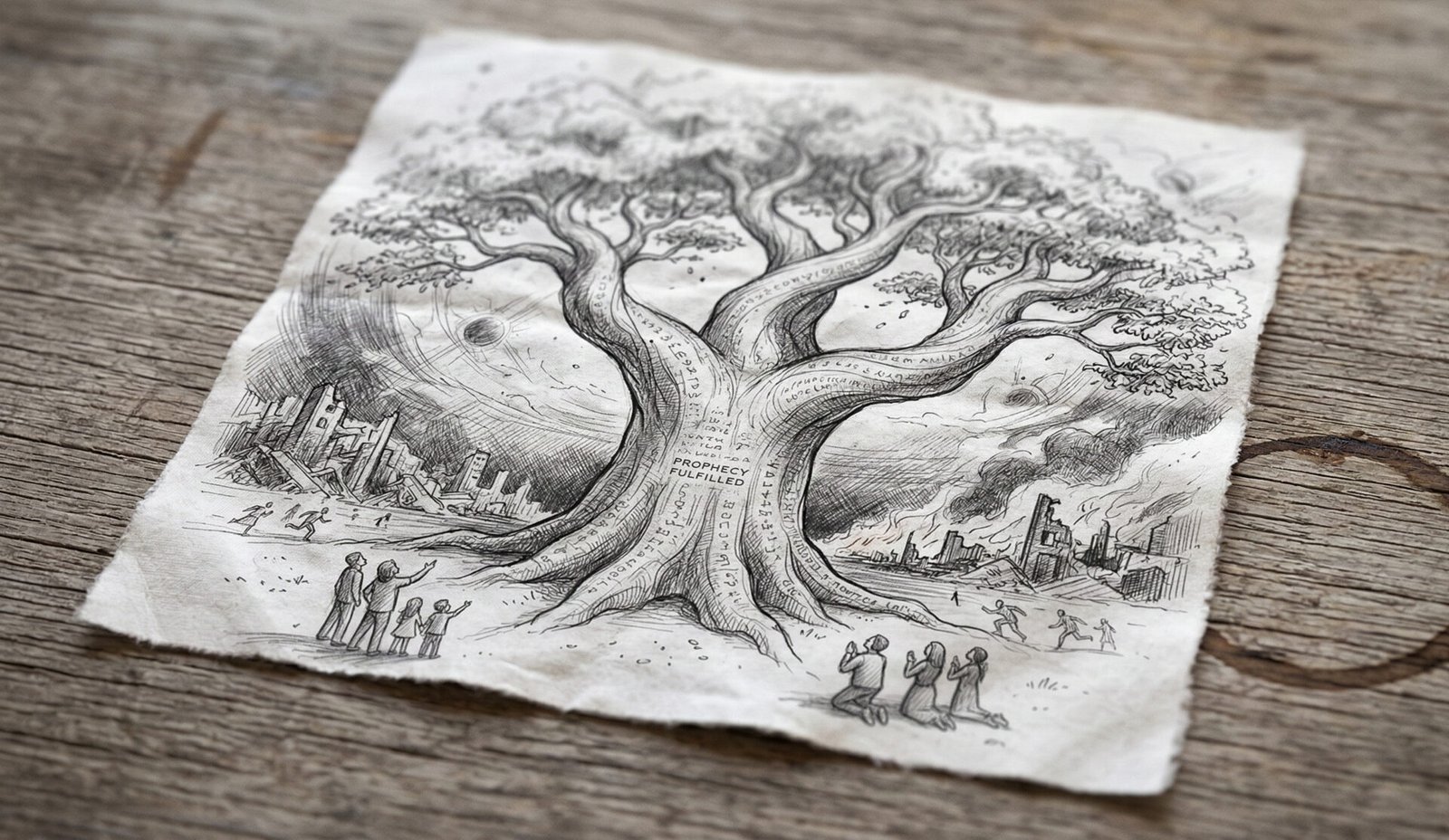
One Tree, Two Branches, The Common Ancestry
To understand why these narratives are so compatible, we have to look at the shared religious substrate of Abrahamic monotheism. Judaism, Christianity, and Islam all share a linear view of history. Unlike circular Eastern philosophies, history in these faiths has a definitive beginning (Creation), a middle (revelation through prophets), and an ordained end (Judgment Day).
It began with the Jewish prophets and their vision of a “Day of the Lord” that would finally set the world right. Christianity then upscaled this vision into a cosmic showdown at Armageddon, a battle so final it required the transformation of reality itself. By the 7th century, Islam had adopted this architecture, but recalibrated the roles to fit the early geopolitical struggles between Islamic empires and “Rome” (the Byzantines). Each iteration didn’t just inherit the dread; it refined it, creating a tiered system of apocalyptic expectations that we are still climbing today.
This commonality is exactly what makes the current geopolitical situation so volatile. Because the narratives share the same DNA, they are perfectly calibrated to one another. Each side’s actions are immediately recognizable to the other as “signs” from their own prophecy.
From Awaiting to “Actioning” the Prophecy
The primary danger of our current moment is the transition from awaiting a prophecy to actioning it. Historically, religious groups often waited for God to act. Today, we are seeing the fusion of ancient scripts with modern military power.
This “actioning” leads to several systemic failures in how we manage global stability:
The Death of Diplomacy: Diplomacy is a secular game of split differences and mutual survival. But when the stakes are cosmic, compromise isn’t a tactic; it’s a betrayal. In the eschatological mindset, a peace treaty isn’t a success, it’s a delay of the inevitable divine victory. You don’t look for middle ground with the Antichrist; you look for his total destruction.
The Mirror Effect: Apocalypticism thrives on mutual reinforcement. When American hardliners use language about “destroying the enemies of God,” it provides the perfect evidence for hardliners in the Islamic world that the Malahim have begun. It becomes a self-fulfilling prophecy, a recursive loop where every missile launched is interpreted as a divine “checkmark” on a cosmic to-do list.
The Loss of Human Agency: There is a profound danger in the abdication of responsibility. By convincing themselves they are merely fulfilling a celestial script, these leaders ignore a darker truth: they are the primary authors of the very catastrophe they seek to attribute to the divine. It is far easier to justify a scorched-earth policy when you believe you’re just holding the pen for God. If the war is “divinely mandated,” the human cost is reframed as merely a necessary step toward a glorious conclusion.
The High Price of a Divine Script
We are currently seeing terms like “anointed” and “divine plan” enter the official lexicon of the 2026 conflict. This represents a move from political strategy to theological determinism.
The tragedy is that by treating the apocalypse as a roadmap, we are effectively building the destination. Both sides are rushing to welcome a Bringer of Peace by paving the road with enough violence to make the very figure they claim to serve unrecognizable. We are writing a tragedy and blaming the Muse.
The lesson of history is fairly consistent, if often ignored: when the gods are drafted into the wars of men, it is the men who suffer, while the gods remain silent. If we are to avoid a man-made disaster of biblical proportions, a return to the cold, secular logic of realpolitikو however flawed it may beو is no longer just a preference; it is a necessity for survival.
I’d love to hear your thoughts on this. Have you noticed this “apocalyptic leakage” in other areas of our public discourse? Beyond the Middle East, are we seeing more political conflicts framed as final, cosmic battles rather than manageable disagreements? Or is there still a way back to a secular realpolitik?
Let’s discuss in the comments.
Bibliography
Amanat, A., 2012. Apocalyptic Islam and Iranian Shi’ism. London: I.B. Tauris. [Available at: https://www.bloomsbury.com/uk/apocalyptic-islam-and-iranian-shiism-9781845119812/]
Arjomand, S.A., 1988. The Turban for the Crown: The Islamic Revolution in Iran. Oxford: Oxford University Press. [Available at: https://global.oup.com/academic/product/the-turban-for-the-crown-9780195042580]
Boyer, P., 1992. When Time Shall Be No More: Prophecy Belief in Modern American Culture. Cambridge, MA: Harvard University Press. [Available at: https://www.hup.harvard.edu/books/9780674951297]
Cohn, N., 1993. Cosmos, Chaos, and the World to Come: The Ancient Roots of Apocalyptic Faith. New Haven: Yale University Press. [Available at: https://yalebooks.yale.edu/book/9780300090888/cosmos-chaos-and-world-come]
Cook, D., 2005. Contemporary Muslim Apocalyptic Literature. Syracuse: Syracuse University Press. [Available at: https://doi.org/10.1007/s11562-009-0092-0]
Filiu, J.P., 2011. Apocalypse in Islam. Berkeley: University of California Press. [Available at:https://www.ucpress.edu/books/apocalypse-in-islam/paper]
Hagee, J., 2007. Jerusalem Countdown: A Warning to the World. Lake Mary, FL: FrontLine. [Available at: https://biblio.es/obra/jerusalem-countdown-por-john-hagee/45470?srsltid=AfmBOooqs4JFsivVfACh96Aj_kxjgTH5MhKH9XVt0p2GlzF3tIW32F7W]
Military Religious Freedom Foundation (MRFF), 2026. Annual Report on Religious Coercion in the US Armed Forces. [Available at: https://eu.usatoday.com/story/news/nation/2026/03/06/iran-war-christian-armageddon-religious-freedom-military/88985753007/]
Spector, S., 2009. Evangelicals and Israel: The Story of American Christian Zionism. Oxford: Oxford University Press. [Available at: https://global.oup.com/academic/product/evangelicals-and-israel-9780195368024,,