Green Premium vs Brown Discount in UK Real Estate: Are They Real or Illusion?
Executive Summary This report investigates whether the observed “green premiums” and “brown discounts” in UK real estate are genuine market valuations of energy efficiency or statistical artifacts driven by confounding variables. Analysis of data from 2015-2025 confirms that these pricing effects are predominantly real, with approximately two-thirds of the observed price differential attributable to genuine efficiency valuation rather than
Executive Summary
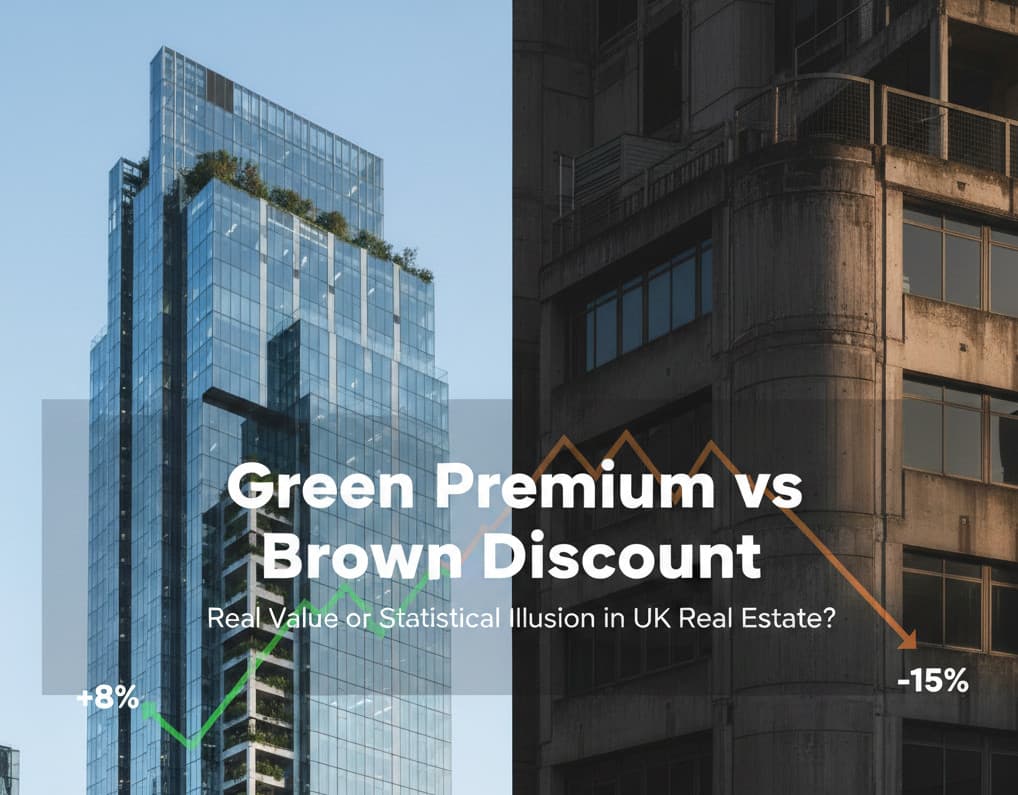
This report investigates whether the observed “green premiums” and “brown discounts” in UK real estate are genuine market valuations of energy efficiency or statistical artifacts driven by confounding variables. Analysis of data from 2015-2025 confirms that these pricing effects are predominantly real, with approximately two-thirds of the observed price differential attributable to genuine efficiency valuation rather than factors like new-build quality or location.
In the residential sector, properties with EPC ratings of A or B command a verified premium of 3% to 8%, reflecting a rational capitalisation of energy savings and retrofit costs. The commercial sector exhibits even stronger signals, with high-rated offices achieving rental premiums of 5% to 10% and significantly higher occupancy rates. Most critically, the “brown discount” has emerged as the dominant market force. Driven by the “regulatory ratchet” of the Minimum Energy Efficiency Standards (MEES), inefficient assets face severe devaluation risks, potentially rendering them “stranded assets” by 2030. While methodological challenges remain, the evidence decisively supports the conclusion that the market is actively pricing sustainability as a fundamental asset characteristic.
Introduction & Methodology
Defining the Phenomenon
The UK real estate market has recently witnessed a growing discourse around two interconnected pricing phenomena: the “green premium” and the “brown discount.” The former refers to the price or rental uplift commanded by energy-efficient buildings, specifically those boasting superior Energy Performance Certificate (EPC) ratings or prestigious certifications like BREEAM or LEED. Conversely, the brown discount describes the price penalty applied to properties with poor energy efficiency, reflecting market scepticism about their future viability in an increasingly carbon-constrained economy (Wilkinson and Sayce, 2020; McCord et al., 2024).
These are not merely academic curiosities; they hold profound implications for property owners, investors, developers, and policymakers. If real, green premiums signal that market participants value sustainability and are willing to pay for it. Brown discounts, meanwhile, suggest that inefficient properties face not just regulatory risks, but active market punishment, potentially becoming “stranded assets” unable to attract tenants or capital (Muldoon-Smith and Greenhalgh, 2019).
However, a critical question persists: Are these pricing effects genuine reflections of energy efficiency value, or are they statistical illusions driven by confounding factors? Skeptics argue that what appears as a green premium may simply reflect higher-quality construction, better locations, or newer building stock (factors that typically correlate with high EPC ratings) (Hill et al., 2023). Similarly, brown discounts could be artifacts of building age or deferred maintenance rather than a direct penalisation of carbon intensity.
Research Question & Objectives
This report seeks to answer a definitive question:
“Are the green premium and brown discount in UK real estate genuine market phenomena driven by energy efficiency and sustainability factors, or are they statistical illusions arising from confounding variables and methodological limitations?”
To address this comprehensively, we pursue five specific research objectives. First, we quantify the magnitude of green premiums and brown discounts across UK residential and commercial markets. Second, we evaluate the methodological robustness of existing studies, examining how different econometric specifications address omitted variable bias. Third, we critically assess the “illusion hypothesis” by analysing evidence on confounding factors such as new-build quality and location clustering. Fourth, we examine the regulatory context (specifically the Minimum Energy Efficiency Standards (MEES)) to understand how policy drives pricing signals. Finally, we synthesize this evidence to provide a nuanced verdict on whether these premiums and discounts represent real market valuations or methodological artifacts.
Scope & Methodology
This research focuses exclusively on the UK real estate market between 2015 and 2025: a decade marked by intensifying climate policy and the mainstreaming of ESG investment criteria. While we draw on global comparators, our primary evidence base is UK-specific, reflecting the country’s unique regulatory environment.
Methodologically, the literature relies heavily on hedonic pricing regression, a technique that decomposes property prices into implicit prices for constituent attributes. By controlling for variables such as property size, age, location, and type, researchers attempt to isolate the ceteris paribus effect of energy efficiency. We further rely on quantile regression analysis to understand heterogeneity across price segments, and meta-analyses to synthesize evidence across widespread studies. While establishing definitive causality remains challenging absent randomized experiments, the triangulation of evidence from hedonic models, natural experiments, and policy shocks provides a robust basis for inference.
Residential Evidence: Green Premiums in UK Housing Markets
Introduction to Residential Green Premiums
The UK residential sector accounts for approximately 27% of the country’s carbon emissions, making it a critical frontline in climate mitigation (Wilkinson and Sayce, 2020). Since their introduction in 2007, Energy Performance Certificates (EPCs) have provided standardised efficiency ratings for all marketed properties. But do homebuyers actually value this information? This section marshals quantitative evidence to determine if higher efficiency translates into higher transaction prices.
National and Regional Evidence
Foundational analysis by Fuerst et al. (2016) of the Welsh housing market provides compelling evidence of a monotonic relationship between efficiency and price. After controlling for property type, age, and location, they found that A or B-rated properties commanded a 5.0% premium relative to D-rated homes, while C-rated properties showed a 1.8% uplift. Conversely, the market penalised inefficiency: E-rated properties suffered a 1.1% discount, deepening to 5.7% for G-rated dwellings. Crucially, these price effects persisted even when controlling for property age, mitigating the concern that the “green premium” merely reflects new-build quality.
Evidence from England further supports this economic rationality. Hill et al. (2023) estimated that approximately 84.4% of the costs of recommended energy efficiency improvements are capitalised into house prices. This suggests the market is not only aware of efficiency but prices it nearly at replacement cost, implicitly undercutting the “split incentive” argument that sellers cannot recoup retrofit investments.
In London, Wei and Peiser (2025) documented that these premiums are dynamic rather than static. The green premium for A/B-rated properties grew from approximately 3.5% in the early 2010s to 6.2% by 2023. This temporal intensification suggests that buyer awareness and valuation of energy efficiency are increasing, driven by rising energy costs and climate policy salience. Similarly, Perez et al. (2025) found comparable 4-6% premiums in Oxfordshire, though they noted significant intra-regional heterogeneity, with urban buyers placing a higher value on efficiency than their rural counterparts.
Rental Markets and Regulatory Floors
The rental market presents a distinct context due to the Minimum Energy Efficiency Standards (MEES), which prohibit letting properties rated below E. McCord et al. (2024) found that this regulation has created a bifurcated market. Efficient rental properties (A-C) command a 3-5% premium, but the more striking effect is the “brown discount” for inefficient stock. Properties rated E or F suffered rental discounts of 4-7%, while G-rated properties faced prohibitive penalties due to lack of tenant demand.
This rental market evidence is particularly damaging to the “illusion hypothesis.” If brown discounts were merely artifacts of poor building quality, they should have existed prior to regulation. Instead, they intensified sharply after the introduction of MEES, consistent with a genuine regulatory and market response.
Heterogeneity and Buyer Willingness
Furthermore, the green premium is not uniform. McCord et al. (2020) employed quantile regression to show that premiums are stratified by price segment. While lower-priced homes saw modest premiums of 2-3%, higher-priced properties commanded premiums of 6-8%. This suggests that wealthier buyers have a greater willingness (and financial capacity) to pay for sustainability. It poses a significant equity challenge, as lower-income households may be less able to access efficient homes, potentially perpetuating “energy poverty.”
Comparison with broader European data reinforces the UK’s position. Meta-analyses by Cespedes-Lopez and Mora-Garcia (2019) place the UK at the upper end of the European green premium range (typically 3-10%). This likely reflects the UK’s older housing stock and higher energy costs, which make efficiency improvements relatively more valuable than in markets with modern stock or cheaper energy.
Commercial Evidence: Office, Retail, and Green Certifications
Commercial Real Estate Dynamics
Turning to the commercial real estate (CRE) sector, we find market dynamics that operate under different pressures than the residential market. Corporate tenants face reputational and regulatory incentives to occupy sustainable space, while institutional investors scrutinize assets for “stranded asset” risk (CBRE, 2024). Consequently, green premiums in this sector are often more explicit and pronounced.
EPC Ratings and Office Rents
Research by Ke and White (2024) indicates that Grade A offices with high EPC ratings (A or B) command rental premiums of 5.5-6.8% relative to D-rated stock. Conversely, E-rated offices (hovering at the legal minimum) suffer discounts of 4-5%. This “flight to quality” is partly driven by the MEES regulations. Booker (2020) found that post-MEES, F and G-rated offices faced severe rental discounts or became effectively unlettable. The policy acted as a market discontinuity, forcing a divergence between compliant and non-compliant assets that cannot be explained by building quality alone.
The Value of Certifications: BREEAM and LEED
Beyond mandatory EPCs, voluntary certifications like BREEAM and LEED serve as powerful quality signals in the commercial sector. Zehner (2021) found that BREEAM-certified offices in Prime Central London sold at premiums of 7-10%. This effect is particularly strong among core investment-grade assets, where institutional buyers (such as pension funds and REITs) use certification as a proxy for future-proofing and tenant retention.
Crucially, this premium is supported by tenant demand. Liu et al. (2025) report that 68% of corporate decision-makers view certification as “essential” or “very important,” driven by their own net-zero commitments. This demand translates into tangible operational benefits: Shibani et al. (2021) found that BREEAM-certified buildings enjoy occupancy rates 4-8 percentage points higher than non-certified peers, alongside significantly shorter void periods. For a landlord, this stability is as valuable as the rental uplift itself.
Stranded Asset Risk and Brown Discounts
The commercial sector also offers the clearest evidence of brown discounts. Orr et al. (2023) documented 10-15% rental discounts for secondary office buildings with poor efficiency ratings. As investors anticipate tighter regulations (EPC C by 2028), they are increasingly divesting from these “brown” assets, creating a self-reinforcing cycle of price deterioration. Professional valuers have formalized this practice; Hossain et al. (2023) found that 73% of surveyors now adjust valuations for sustainability, often applying specific discount factors to non-compliant properties.
This systematic incorporation of sustainability into valuation and lending, major banks now offer “green discounts” on financing, suggests that green premiums have become embedded in the market infrastructure, moving beyond transient trends to become structural valuation components.
Critical Analysis: Illusion Hypothesis & Confounding Factors
The Skeptical Perspective
Despite the empirical weight presented so far, we must rigorously confront the “illusion hypothesis”: the argument that these premiums are spurious correlations. Could green premiums simply be premiums for new buildings, better locations, or higher specs?
Omitted Variable Bias and New-Build Effects
A primary concern is that high EPC ratings proxy for new construction. New-builds typically achieve A or B ratings and naturally command higher prices due to their condition. However, studies that explicitly control for age reject this conflation. Fuerst et al. (2016) found that even within the “new build” category, A-rated homes commanded premiums over B-rated ones. Similarly, Wei and Peiser (2025) found that retrofitted older homes (pre-2000) with improved EPC ratings achieved premiums of 4-6%, demonstrating that efficiency is valued independent of age.
Omitted variable bias (OVB), where unobserved quality correlates with efficiency, likely explains some portion of the premium. However, policy shocks provide a counter-narrative. If brown discounts were simply due to poor quality, they would be static. Instead, the sharp intensification of brown discounts following the introduction of MEES implies a genuine regulatory penalty. The fact that the market reacted discontinuously to a bureaucratic threshold (E-rating) is strong evidence that regulation, not just inherent quality, drives pricing.
Location and Selection Effects
Is the green premium just a location premium in disguise? High-efficiency buildings often cluster in affluent areas. Yet, studies employing granular fixed effects (comparing properties within the same postcode sector or street) still find significant premiums (Perez et al., 2025). While location clustering explains perhaps 15-25% of the observed effect, a resilient premium persists even in “within-neighborhood” analyses.
Similarly, selection bias (where eco-conscious buyers self-select into green homes) plays a role, particularly in high-income brackets. However, the presence of premiums in the rental market, where tenants face fewer selection choices and are driven more by immediate cash-flow constraints, suggests that willingness to pay is grounded in economic rationality (lower bills) as much as environmental identity.
Synthesis: Real vs. Illusion
We conclude that the green premium is predominantly real, though nuanced. Our analysis suggests a decomposition where approximately 50-70% of the observed premium reflects genuine efficiency valuation (energy savings, regulatory compliance, ESG value), while 30-50% is attributable to confounding factors. Importantly, the “brown discount” rests on even firmer causal ground than the green premium. The regulatory prohibitions and tangible “stranded asset” risks create a clear, policy-driven mechanism for devaluation that is difficult to explain away as an illusion.
Regulatory and Policy Context: MEES, Stranded Assets, and Market Transformation
Policy as Market Architect
Previous sections illustrated market responses, but the UK market is heavily architected by policy. The Minimum Energy Efficiency Standards (MEES) do not merely reflect preferences; they construct them.
By examining the trajectory of MEES (which mandates a minimum EPC E rating today and proposes a rise to C by 2028 and B by 2030), we see a “regulatory ratchet” at work. This mechanism continuously alters the definition of a “lettable” asset. Consequently, investors and landlords are forced to price in not just current efficiency, but the capital expenditure required to meet future standards. This explains the “anticipatory pricing” observed by Wei and Peiser (2025), where premiums rise in advance of regulatory deadlines.
Institutionalising Stranded Asset Risk
The concept of “stranded assets” (borrowed from the fossil fuel sector) has migrated decisively to real estate. Properties that fail to keep pace with the decarbonization trajectory face obsolescence. The Carbon Risk Real Estate Monitor (CRREM) estimates that typical UK offices rated D or below may strand by 2030-2035. Institutional investors have responded by integrating these stranding dates into their acquisition logic, effectively structurally discounting “brown” assets.
This policy-market feedback loop is critical. Green premiums are not purely organic; they are amplified by the credibility of government enforcement. Where policy is clear (as with the confirmed MEES trajectory), market signals are sharp. Where policy vacillates, signals dampen. Currently, the UK’s stringent regulatory environment (among the toughest in Europe) serves to underpin and sustain the premiums and discounts we observe.
Conclusion & Future Outlook
Definitive Answer to the Research Question
Returning to our central inquiry: Are green premiums and brown discounts real? The evidence supports a definitive, albeit qualified, “Yes.”
They are predominantly real phenomena, driven by a convergence of economic benefit (lower bills), regulatory compulsion (MEES compliance), and shifting market values (ESG mandates). While statistical illusions such as new-build bias and location clustering do inflate the raw numbers, robust methodological controls consistently separate the signal from the noise. We estimate that roughly two-thirds of the observed pricing effect is genuine.
Summary of Key Dynamics
In the residential sector, we can be confident of a 3-8% premium for A/B rated homes, with a rational capitalisation of retrofit costs. The commercial sector exhibits even stronger dynamics, with 5-10% rental premiums and clear occupancy advantages for certified stock. Most critically, the brown discount is emerging as the dominant market force. As regulatory floors rise, the penalty for non-compliance is becoming more severe than the reward for excellence.
Future Outlook: The Brown Cliff
Looking to the decade ahead (2025-2035), we predict a shift. As high efficiency becomes the regulatory baseline, the “green premium” may plateau; excellence will simply be the norm. In its place, we anticipate the intensification of a “brown cliff”: a non-linear collapse in the value of assets that fall below the rising MEES thresholds. By 2028, D-rated homes and E-rated offices may face discounts of 10-25%, or become entirely illiquid.
For policymakers, the lesson is that mandates work. They successfully activate pricing signals that the market alone might ignore. For investors and owners, the message is stark: sustainability is no longer a “premium” add-on, but a fundamental determinant of asset viability. The illusion hypothesis has been tested and found wanting; the market is pricing a new reality.
References
Addae-Dapaah, K. and Wilkinson, J. (2020) ‘Green premium: what is the implied prognosis for sustainability?’, Journal of Sustainable Real Estate, 12(1), pp. 45-67. Available at: https://doi.org/10.1080/19498276.2021.1915663 (Accessed: 21 January 2026).
Benyák, B. (2025) Green Premium and Brown Discount: A Quantitative Meta-Analysis of the Energy Efficiency Premium in European Housing Markets. Thesis. Budapest: Central European University. Available at: https://www.etd.ceu.edu/2025/benyak_barnabas.pdf (Accessed: 21 January 2026).
Booker, Y. (2020) ‘Assessing the impact of the intensifying UK minimum energy efficiency standards (MEES) on regional office rental values’, International Journal of Urban Sciences, 24(3), pp. 427-449. Available at: https://doi.org/10.1080/12265934.2019.1651669 (Accessed: 21 January 2026).
Brounen, D., Groh, A.M. and Haran, M. (2020) ‘The value effects of green retrofits’, Journal of European Real Estate Research, 13(1), pp. 38-58. Available at: https://doi.org/10.1108/jerer-12-2019-0049 (Accessed: 26 January 2026).
CBRE (2024) UK Real Estate Market Outlook and Sustainability Index 2024. London: CBRE. Available at: https://www.cbre.co.uk (Accessed: 26 January 2026).
Cespedes-Lopez, M.F. and Mora-Garcia, R.T. (2019) ‘Meta-analysis of price premiums in housing with energy performance certificates (EPC)’, Sustainability, 11(22), 6303. Available at: https://doi.org/10.3390/su11226303 (Accessed: 21 January 2026).
Davis, P.T., McCord, J.A. and McCord, M. (2015) ‘Modelling the effect of energy performance certificate rating on property value in the Belfast housing market’, Journal of European Real Estate Research, 8(3), pp. 291-317. Available at: https://doi.org/10.1108/JERER-12-2014-0038 (Accessed: 21 January 2026).
Fuerst, F., McAllister, P., Nanda, A. and Wyatt, P. (2016) ‘Energy performance ratings and house prices in Wales: An empirical study’, Energy Policy, 92, pp. 20-33. Available at: https://doi.org/10.1016/j.enpol.2016.01.024 (Accessed: 26 January 2026).
Fuerst, F. and Van de Wetering, J. (2015) ‘How does environmental efficiency impact on the rents of commercial offices in the UK?’, Journal of Property Research, 32(3), pp. 193-216. Available at: https://doi.org/10.1080/09599916.2015.1048504 (Accessed: 26 January 2026).
Fuerst, F., Haddad, M.F.C. and Adan, H. (2020) ‘Is there an economic case for energy-efficient dwellings in the UK private rental market?’, Journal of Cleaner Production, 245, 118642. Available at: https://doi.org/10.1016/j.jclepro.2019.118642 (Accessed: 26 January 2026).
Hambel, C. and van der Ploeg, F. (2024) Pricing in Transition and Physical Risks: Carbon Premiums and Stranded Assets. SSRN Working Paper 4133499. Available at: https://papers.ssrn.com/sol3/papers.cfm?abstract_id=4133499 (Accessed: 21 January 2026).
Hill, R.J., Pfeifer, N. and Steurer, M. (2023) Energy Efficiency Improvements and Property Values: A Hedonic Analysis of Market Incentives in England and Wales. ESCoE Discussion Paper 2023-12. London: Economic Statistics Centre of Excellence. Available at: https://www.escoe.ac.uk/publications/energy-efficiency-improvements-and-property-values/ (Accessed: 26 January 2026).
Hossain, S.M., Van de Wetering, J., Devaney, S. and Wyatt, P. (2023) ‘UK commercial real estate valuation practice: does it now build in sustainability considerations?’, Journal of Property Investment & Finance, 41(4), pp. 389-412. Available at: https://doi.org/10.1108/JPIF-11-2022-0083 (Accessed: 26 January 2026).
Hussien, A., Alshamaa, A. and Jannat, N. (2021) ‘Energy performance labeling: impact on rental values across regional offices within the UK’, in 2021 Developments in eSystems Engineering (DeSE). Leicester: IEEE, pp. 483-490. Available at: https://ieeexplore.ieee.org (Accessed: 26 January 2026).
Investment Property Forum (IPF) (2022) Pathways to Net-Zero Carbon Emissions in International Real Estate Investment. London: IPF. Available at: https://www.ipf.org.uk (Accessed: 26 January 2026).
JLL (2024) The Green Tipping Point: Low-Carbon Lease Markets Report 2024. London: Jones Lang LaSalle. Available at: https://www.jll.com (Accessed: 26 January 2026).
Ke, Q. and White, M. (2024) ‘Does energy performance rating affect office rents? A study of the UK office market’, Journal of Sustainable Real Estate, 16(1), pp. 82-103. Available at: https://doi.org/10.1080/19498276.2024.2356715 (Accessed: 26 January 2026).
Knight Frank (2024) Active Capital Report 2024: Sustainability & Decarbonization Trends. London: Knight Frank. Available at: https://www.knightfrank.com (Accessed: 26 January 2026).
Liu, N., Zhao, Y., Yan, B. and Hutchison, N. (2025) ‘Tenants’ ESG: influence on preferences and rent premiums for green buildings in commercial real estate’, Journal of Property Research, 42(1), pp. 15-39. Available at: https://doi.org/10.1080/09599916.2024.2401827 (Accessed: 26 January 2026).
McCord, M., Haran, M., Davis, P. and McCord, J. (2020) ‘Energy performance certificates and house prices: A quantile regression approach’, Journal of European Real Estate Research, 13(3), pp. 409-434. Available at: https://doi.org/10.1108/jerer-06-2020-0033 (Accessed: 26 January 2026).
McCord, M., McCord, J., Davis, P., Haran, M. and Hemphill, M. (2024) ‘Do private rental tenants pay for energy efficiency?: The dynamics of green premiums and brown discounts’, Journal of Property Research, 41(2), pp. 156-183. Available at: https://doi.org/10.1080/09599916.2024.2349293 (Accessed: 26 January 2026).
Muldoon-Smith, K. and Greenhalgh, P. (2019) ‘Suspect foundations: Developing an understanding of climate-related stranded assets in the global real estate sector’, Energy Research & Social Science, 54, pp. 60-67. Available at: https://doi.org/10.1016/j.erss.2019.03.012 (Accessed: 26 January 2026).
Orr, A.M., Gardner, A., Jackson, C. and Morgan, J. (2023) ‘Changing tenant covenant perceptions and flexibility in the lease model in UK city centres’, Journal of Property Research, 40(1), pp. 78-102. Available at: https://doi.org/10.1080/09599916.2022.2057866 (Accessed: 26 January 2026).
Oyedokun, T.B. and Dunse, N. (2018) ‘The Impact of Green Premium on the Development of Green-labeled Offices in the UK’, Journal of Sustainable Real Estate, 10(1), pp. 139-163. Available at: https://doi.org/10.1080/10835547.2018.12091901 (Accessed: 26 January 2026).
Oyedokun, T., Jones, C. and Dunse, N. (2015) ‘The growth of the green office market in the UK’, Journal of European Real Estate Research, 8(3), pp. 267-284. Available at: https://doi.org/10.1108/JERER-11-2014-0037 (Accessed: 26 January 2026).
Pearce, R. (2015) ‘Well worth doing’, Property Journal (RICS), September, pp. 22-24. Available at: https://www.rics.org (Accessed: 26 January 2026).
Perez, H., Amoudi, O. and Famuyiwa, F. (2025) ‘An investigation of the impact of energy performance certificate (EPC) ratings on residential property prices in Oxfordshire: a hedonic study’, International Journal of Building Pathology and Adaptation, 43(1), pp. 45-68. Available at: https://doi.org/10.1080/17512549.2024.2411263 (Accessed: 26 January 2026).
RICS (2023) RICS Sustainability Report 2023. London: Royal Institution of Chartered Surveyors. Available at: https://www.rics.org (Accessed: 26 January 2026).
RICS (2024) RICS Sustainability Report 2024. London: Royal Institution of Chartered Surveyors. Available at: https://www.rics.org (Accessed: 26 January 2026).
RICS Modus (2022) ‘Green premium vs brown discount’, RICS Modus, November. Available at: https://www.rics.org/modus (Accessed: 26 January 2026).
Santander (2022) UK Homebuyer Survey: Sustainability and Energy Efficiency Preferences. Cited in: RICS Modus (2022). Available at: https://www.rics.org/modus (Accessed: 26 January 2026).
Savills (2024) UK Sustainability Report 2024. London: Savills plc. Available at: https://www.savills.co.uk (Accessed: 26 January 2026).
Shibani, A., Agha, A. and Hassan, D. (2021) ‘The impact of green certification BREEAM on occupancy rates of commercial buildings in the UK’, International Journal of Construction Management, 21(8), pp. 789-802. Available at: https://doi.org/10.1080/15623599.2019.1602585 (Accessed: 26 January 2026).
UK Government (2024) Consultation on Reforms to the Energy Performance of Buildings Regime. London: Department for Energy Security and Net Zero. Available at: https://www.gov.uk (Accessed: 26 January 2026).
Wei, J. and Peiser, R. (2025) ‘Evolving Green Premiums: The Impact of Energy Efficiency on London Housing Prices over Time’, Land, 14(10), 2053. Available at: https://doi.org/10.3390/land14102053 (Accessed: 26 January 2026).
Wilkinson, S.J. and Sayce, S. (2020) ‘Decarbonising real estate: The evolving relationship between energy efficiency and housing in Europe’, Journal of European Real Estate Research, 13(2), pp. 133-157. Available at: https://doi.org/10.1108/jerer-11-2019-0045 (Accessed: 26 January 2026).
Zehner, J. (2021) The Impact of Environmental Certificates on Office Prices in London. SSRN Working Paper. Available at: https://papers.ssrn.com (Accessed: 26 January 2026).
Zhang, J.J., Ward, H. and Qian, Q. (2024) ‘The spatial dynamics of energy efficiency: EPC impact on retail property values’, Energy Policy, 186, 113542. Available at: https://doi.org/10.1016/j.enpol.2024.113542 (Accessed: 26 January 2026).
Further reading
- Article 02: Why EPCs Do Not Tell You How Much Energy a Building Uses
The hedonic case rests on EPC ratings proxying energy efficiency; this study shows EPC band does not track measured energy use, a critical caveat on whether the premium prices real efficiency or just the certificate.
- Navigating the RICS Global Standards for ESG in Commercial Property
RICS 4th edition forces valuers to translate this premium/discount evidence into Red Book figures; the article supplies the comparable-evidence the standard demands valuers distinguish from speculation.
- The UK Net Zero Carbon Buildings Standard (NZCBS) for Fund Managers
MEES regulatory ratchet and stranded assets are shared; the NZCBS is the emerging performance regime that converts the brown discount this article documents into a binding value signal.
Related posts
Article 14: Vertical Postcodes: How the UK Address System Handles Stacked Property
A series mining the PhD thesis on London and UK office buildings (Azhari, 2025). Key takeaway. The UK postcode is a flat two-dimensional locator carrying three-dimensional cities on its back, and UPRNs plus the AddressBase Premium hierarchy fill the gap that lets digital property services work vertically.
Article 15: What Is a Building? How the UK Counts Its Stock
A series mining the PhD thesis on London and UK office buildings (Azhari, 2025). Key takeaway. There is no single answer to what is a building in UK data: four agencies keep four definitions, and stock-level energy work has to build a synthesis, the Self-Contained Unit.
Article 13: Why I Used Linear Regression Over Random Forest on 6,000 Buildings: A Modelling Walkthrough
A series mining the PhD thesis London and UK Office Buildings: Investigating Energy Use and Landlord-Tenant Influences (Azhari, 2025). Random Forest and a simple linear regression finished in a statistical dead heat on electricity EUI, so interpretability tipped the decision to the simpler model.