
How an ordinary teenager came to out-know Ptolemy, and why the same structural progress makes every one of us more ignorant than anyone who has ever lived.
Hand a modern fifteen-year-old a blank sheet of paper and ask them to map the architecture of the cosmos, and they will sketch, without a moment’s hesitation, a reality that the greatest minds of the Roman Empire spent lifetimes failing to see.
They will describe a universe roughly fourteen billion years old, perpetually expanding, where our Sun is merely an ordinary star among hundreds of billions in a single galaxy, itself lost among billions more. They will explain that the Earth is a sphere in orbit, that disease is driven by microscopic pathogens rather than humours, and that the blueprint of life is encoded in a double-helix molecule.
Only one ancient intuition survives this comparison intact: classical atomism, guessed at by Democritus and beautifully rendered in the verse of Lucretius. Yet, for the ancients, the atom was a philosophical hunch—unquantified, unverifiable, and static. For the teenager, it is a measured entity nested within a highly tested, mathematically rigorous framework.
The teenager is not a genius for knowing this. They have not worked harder, nor are they equipped with a more powerful cognitive engine than Ptolemy, Ibn Sina, or Leonardo da Vinci. They were simply standing on the escalator of human civilization when it reached this particular floor.
This is a remarkable phenomenon, but it conceals a profound structural paradox. The very infrastructure that lifts an ordinary modern adolescent far above the summits of antiquity also guarantees that the teenager, the university professor, and the leading specialist now hold a smaller share of collective human knowledge than any educated person in history.
As a civilisation, our cognitive floor is rising. But our cognitive ceiling is rising very much faster. To understand the modern mind, we must hold both of these truths together, analysing the elegant system that carries us upward and the quiet trade-offs we make along the way.
1. The Rising Floor and Cognitive Inflation
Begin with the aspect of this paradox that is easiest to observe: cognitive inflation. This is the steady, almost invisible upward drift of our baseline intellectual expectations.
In the first century, the peak of natural philosophy was a geocentric cosmos and a medicine of bodily fluids. When Pliny the Elder compiled the known world into his Natural History, he got a spectacular amount of it wrong. This was not a failure of raw intellect. Pliny’s mind was formidable, but the structural inputs available to him were thin, scattered, and uncorrected.
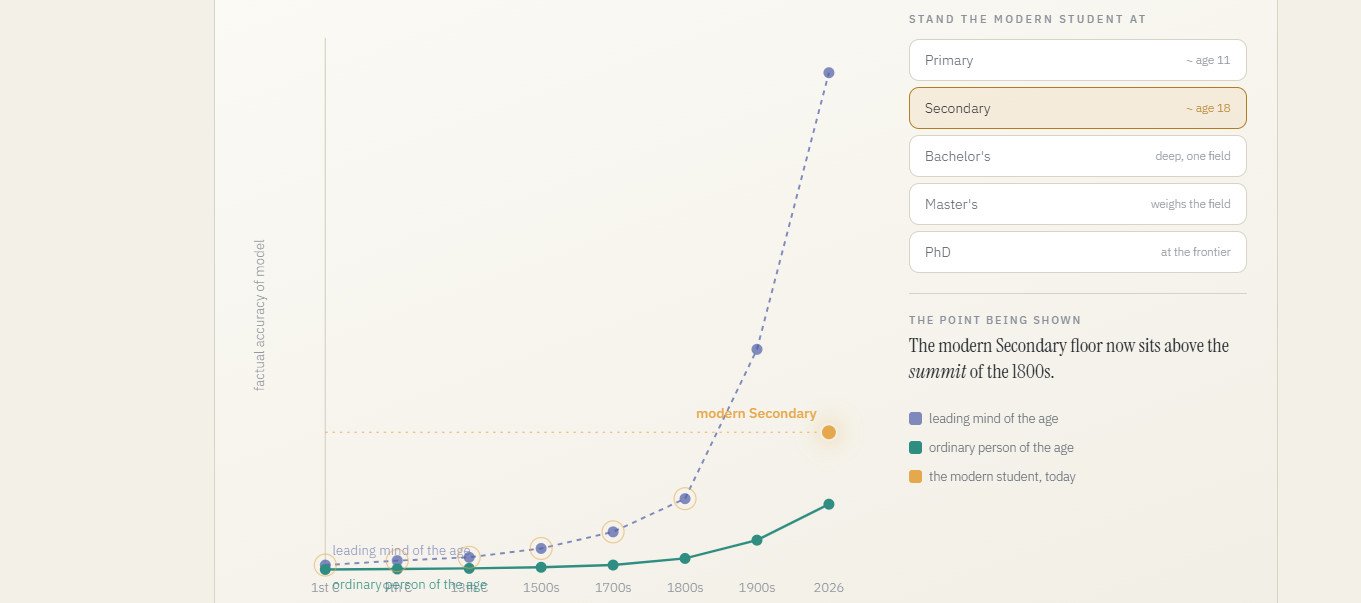
Set Pliny’s summit against an eleven-year-old who has just finished primary school today. On the fundamental question of how the physical world is arranged, the child carries a vastly superior, more factually accurate model. They know the continents drift on tectonic plates; they know that gravity curves space-time; they know that blood circulates. The floor of settled factual description has risen so high that it now sits well above the historical ceiling.Track this upward movement through our formal educational systems, and the inflation becomes systematic. By eighteen, a secondary school graduate carries a compressed, highly curated summary of human achievement that no Renaissance court could have assembled: algebra as a routine utility, Newtonian mechanics treated as a formula rather than an epiphany, the periodic table, cellular division, and the broad brushstrokes of global history.
A Bachelor’s degree trades this breadth for depth, introducing the student to a domain with its own specialized architecture. A modern chemistry graduate routinely models molecular orbitals that would have looked like sorcery to an eighteenth-century alchemist. The Master’s degree shifts the student’s relationship to knowledge itself—from passively receiving it to actively weighing it. Finally, the doctorate pushes the candidate to the very edge of the known, tasking them with expanding that boundary by a margin so small it is often invisible to the outside world.
This is the escalator in action. It does not require its passengers to be exceptional; it requires only that the collective, error-correcting infrastructure of schooling operates continuously. It uploads several centuries of hard-won discovery into a developing mind over the course of two decades. The teenager did not climb to this view; they were carried. The achievement belongs to the system, not the passenger.
Cognitive Inflation: Over historical centuries, humanity has systematically externalised discoveries, creating an intellectual platform that is continuously elevated. This visualisation shows how the common modern baseline (the floor) has climbed completely past ancient and medieval ceilings. Modern graduates stand on structural scaffolding built by centuries of collective cognitive labour.
2. Rented vs. Owned Knowledge: The Great Trade-Off
Does this factual superiority mean the modern teenager is intellectually superior to a scholar of the sixteenth century? To answer this honestly, we must split the question in two, revealing a fundamental distinction between rented knowledge and owned knowledge.
The modern student wins on factual volume and accuracy, and it is not a close contest. They carry, pre-loaded, truths that Copernicus, Galileo, and Leonardo spent entire careers groping toward and ultimately missed.
However, when we evaluate how that knowledge is held, the balance shifts. There is no biological evidence to suggest that the raw cognitive horsepower of a modern human exceeds that of our ancestors. The real difference lies in the nature of our intellectual acquisition:
Rented Knowledge: The modern teenager knows that water is made of two parts hydrogen to one part oxygen. They know this because they were told. If the textbooks vanished and the databases went dark, they could not derive this fact, prove it, or reconstruct the experimental apparatus required to discover it. They hold it securely enough to use, but they do not own it.
Owned Knowledge: A sixteenth-century scholar held a fraction of the facts we do, but a far higher proportion of their knowledge was owned. It was reconstructed from first principles, defended through long chains of reasoning they had personally walked, and verified by their own hand.
Because their inputs were thin and unreliable, the only knowledge historical scholars could trust was knowledge they could personally derive. Their era trained derivation the way ours trains retrieval.
┌──────────────────────────────────────────────────────────┐
│                   THE KNOWLEDGE BALANCE                  │
├────────────────────────────┬─────────────────────────────┤
│  THE HISTORICAL SCHOLAR    │     THE MODERN STUDENT      │
├────────────────────────────┼─────────────────────────────┤
│  • Low Volume (Few Facts)  │  • High Volume (Many Facts) │
│  • Highly "Owned"          │  • Highly "Rented"          │
│  • Derived from First Prin.│  • Retrieved on Demand      │
│  • Deeply Self-Contained   │  • Interface to Sys. Store  │
└────────────────────────────┴─────────────────────────────┘
This distinction reframes the classic thought experiment of dropping a historical genius like Leonardo da Vinci into a modern university classroom. In the popular telling, Leonardo fails his first physics quiz, spends eighteen months catching up, and then promptly re-establishes himself as a leading contemporary mind.
This illustration is useful because it highlights the bottleneck: for Leonardo, the challenge would merely be acquiring “rented” facts, a matter of rapid ingestion. For the modern student, the inverse is true. The facts arrive free, but the “ownership”, the ability to derive, challenge, and reconstruct those facts, is incredibly expensive. Much of modern education quietly bypasses ownership altogether because the escalator does not strictly require it.
To be fair, no individual derivation is entirely self-made. The historical scholar who reconstructed a geometric proof was still using tools, languages, and mathematical notations inherited from others. Owned knowledge is owned because the individual can rebuild it without consulting an answer key, not because they invented the scaffolding itself.
The division between rented and owned is a spectrum, not a wall. But what the escalator has done is shift the center of gravity for the entire human population. We have surrendered owned depth in exchange for collective, rented breadth.
The trade-off: Switch to the Linear Scale to appreciate the pure scale difference. The volume of knowledge held by a modern Master's or PhD graduate completely dwarfs historical giants. Yet, look at the ratio within: the historical peak was almost entirely "owned" due to the necessity of derivation, whereas modern education trades individual self-containment for a massive library of rented concepts.
3. The Vanishing Fraction and the Extinction of the Polymath
To understand why this trade-off was necessary, we must look at the geometry of human progress.
Imagine the sum of what humanity collectively knows as a circle. In the first century, this circle was small. By 1500, it had expanded; by 1900, it was larger still. Today, the circle has grown to a scale that defies imagination, doubling in size on the timescale of a typical university degree.
Inside this ever-expanding circle, draw a second shape: the maximum volume of information a single, well-educated human head can personally hold. This inner shape has grown too, thanks to the escalator of modern schooling, but it grows linearly and slowly. It is strictly bounded by the unchanging volume of the human skull and the static span of a human lifetime.
THE GEOMETRICAL SQUEEZE:

      Ancient Era                  Renaissance                  Modern Era
     (Circa 100 AD)               (Circa 1500 AD)              (Circa 2026 AD)

        ┌──────┐                    ┌──────────┐                ┌──────────────┐
        │ ──   │                    │  ────    │                │    •         │
        └──────┘                    └──────────┘                └──────────────┘
    Individual held              Individual held              Individual holds
    a significant %             a tiny but visible %         a vanishing fraction
   of collective store          of collective store           approaching zero
Because of this geometrical asymmetry, the ratio between individual capacity and collective knowledge does not rise across history. It collapses.
A medieval scholar in 1200 could realistically hold a significant double-digit percentage of the formal, recorded knowledge of their entire civilisation. A modern PhD, vastly more learned in absolute terms, holds a share of human knowledge so close to zero that it cannot be useful as a percentage.
This dissolves our initial paradox:
The teenager does out-know Ptolemy, because the teenager’s small disk of rented knowledge completely engulfs the tiny, entire circle of the ancient world.
Yet, that same teenager, and the university professor standing next to them, is profoundly more ignorant than any educated historical figure, because their individual disk of knowledge represents a vanishingly small sliver of our current collective circle.
This geometric reality explains why the polymath is extinct. In 1500, the interior of any given scholarly field was shallow enough that an exceptionally gifted mind could cross it quickly and reach the active frontier of multiple disciplines simultaneously.
By 1900, simply crossing the interior of physics consumed a working lifetime. Today, crossing the interior of a single sub-field of organic chemistry takes a decade, after which a researcher can hope to push the frontier outward by the width of a hair.
The Renaissance mind was not crushed by a decline in human talent. It was squeezed out by geometry. Specialisation is not a failure of curiosity; it is the only remaining physical strategy for a finite mind operating within an infinite circle.
4. The Expanding Circumference and Intellectual Humility
There is a classic pedagogical metaphor, often attributed to various university blackboards, that captures this relationship beautifully.
If the area of a circle represents what you know, its circumference represents your point of contact with what you do not know. As you enlarge the area of your knowledge, you inevitably lengthen the perimeter of your ignorance. The more you know, the more of the unknown you find yourself pressed against.
  SMALL KNOWLEDGE (Narrow Horizon)        LARGE KNOWLEDGE (Expanded Horizon)

            ┌───┐                                    ┌───────────┐
            │   │  <- Short boundary                 │           │  <- Long boundary
            └───┘     with unknown                   │           │     with unknown
                                                     └───────────┘
This model predicts something that the simple “rising floor” narrative cannot explain. If knowledge were merely an accumulative asset, the highly educated would feel the most complete, confident, and secure. Instead, they routinely report the opposite: a persistent, low-grade awareness of their own limitations.
The empirical literature on cognitive self-assessment supports this. While early work by Dunning and Kruger (1999) famously claimed that the least competent are the most confident, modern statistical reviews (Nuhfer et al., 2016; Gignac & Zajenkowski, 2020) suggest the pattern is more nuanced—often an artifact of statistical regression to the mean and general overconfidence.
Yet, the core philosophical point remains sound: genuine expertise does not deliver a sense of completeness. It delivers an intimate, highly detailed map of the frontier. It shows you exactly where the light ends and the dark begins.
Intellectual humility is not a performative virtue we add to learning to appear polite. It is the literal sensation of standing at the edge of an immense circumference.
vs the average citizen
vs the leading scholar
Visualisation Guide: These parallel circular charts plot cognitive capacity on a shared logarithmic scale. The outer dashed boundaries represent the total verified knowledge of 2026. As you shift educational stages, notice how a modern student's gold disk completely swallows the intellectual summits of antiquity and the Middle Ages—yet collapses into a microscopic sliver when assessed against today's collective boundary.
5. The Scaffolding Outside Ourselves
If no individual head can hold more than a tiny fraction of what we know, how does our complex, highly technological civilisation continue to function without collapsing?
It functions because human knowledge was never designed to fit inside a single head.
The economist Friedrich Hayek made this point central to his analysis of systems: the information required to run a society does not exist in a concentrated state; it is dispersed in millions of fragments across a vast network of individuals.
Leonard Read illustrated this beautifully in his famous essay, I, Pencil, showing that not a single human being on earth knows how to make a simple wooden pencil from scratch. The knowledge of logging, mining graphite, mixing lacquer, smelting brass, and organizing global logistics is distributed across thousands of minds who have never met and never will.
In their work The Knowledge Illusion, cognitive scientists Steven Sloman and Philip Fernbach argue that we think in communities. We store the vast majority of our “knowledge” in other people, in our physical instruments, and in our institutional processes. We then routinely mistake this external community store for our own individual capacity.
The expanding circle forced us to externalise our genius. We poured our derived, owned knowledge into books, databases, software, and physical infrastructure. We then gave each new generation a lightweight, rented interface to access it.
The modern teenager is a walking interface to an immense external hard drive. The Renaissance scholar was a denser, more self-contained, but vastly more limited system. They are simply different architectural solutions to differently sized circles of knowledge.
6. The Automated Handrail: What Happens When the Scaffolding Thinks?
We are now adding a completely new feature to this escalator.
For the entirety of human history, our externalised knowledge was inert. The libraries of Alexandria, the archives of the British Museum, and the databases of the internet sat quietly, waiting for a human mind to formulate a question, execute a query, and personally synthesize the response.
A system that can generate fluent, context-aware knowledge on demand changes the very nature of this contract.
Generative AI lowers the transaction cost of renting knowledge to absolute zero. If the “rising floor” logic holds, this should trigger another massive wave of cognitive inflation, lifting our collective baseline once again.
But it also poses an unprecedented risk to the element of the escalator we have already spent centuries neglecting: ownership.
If owning knowledge means having the capacity to derive, critique, and defend a truth without relying on an external system, and we now have an automated handrail that does all the deriving, writing, and coding for us on demand, the incentive to ever own anything intellectually begins to decay.
The optimistic view is that this automation frees us from the burden of rote retrieval, allowing our finite minds to focus on the high-level work of synthesis, strategic judgment, and deciding which new directions the circle should expand toward.
The pessimistic view is that we are raising our collective floor while quietly losing the distributed, individual capacity to reconstruct that floor if the external store should ever fail.
We do not yet know which of these paths we will take. We are standing on a newly drawn, highly unstable boundary line, peering out into a wide and silent frontier, and wondering whether the tool in our hands is a step upward—or the moment the escalator finally runs out of track.
Scientometric Appendix & References
The “knowledge circle” described in this essay is a conceptual model, but its underlying dynamics are heavily supported by empirical data in the field of scientometrics (the quantitative study of science and scientific publication):
Exponential Growth: Studies tracking the volume of scientific literature consistently show exponential trends. Derek de Solla Price (1963) pioneered this analysis, estimating that the scientific enterprise doubles every 10 to 15 years.
Contemporary Estimates: Modern bibliometric analyses by Bornmann and Mutz (2015) confirm this long-term trend, showing an overall growth rate of about 4% per year (doubling every 17 years) based on publication counts from 1900 to 2018. When measured using cited references for the post-war period, the growth rate rises to 8–9% per year, which equates to a doubling time of approximately 9 years.
Bibliography
Bornmann, L., & Mutz, R. (2015). Growth rates of modern science: A bibliometric analysis based on the number of publications and cited references. Journal of the Association for Information Science and Technology, 66(11), 2215–2222.
Bornmann, L., Haunschild, R., & Mutz, R. (2021). Growth rates of modern science: A latent piecewise growth curve approach to model publication numbers from established and new literature databases. Humanities and Social Sciences Communications, 8, 224.
Dunning, D., & Kruger, J. (1999). Unskilled and unaware of it: How difficulties in recognizing one’s own incompetence lead to inflated self-assessments. Journal of Personality and Social Psychology, 77(6), 1121–1134.
Fuller, R. B. (1981). Critical Path. St. Martin’s Press.
Gignac, G. E., & Zajenkowski, M. (2020). The Dunning-Kruger effect is (mostly) a statistical artefact: Valid approaches to testing the hypothesis with individual differences data. Intelligence, 80, 101449.
Hayek, F. A. (1945). The use of knowledge in society. The American Economic Review, 35(4), 519–530.
Mabe, P. A., & West, S. G. (1982). Validity of self-evaluation of ability: A review and meta-analysis. Journal of Applied Psychology, 67(3), 280–296.
Nuhfer, E., Cogan, C., Fleisher, S., Gaze, E., & Wirth, K. (2016). Random number simulations reveal how random noise affects the measurements and graphical portrayals of self-assessed competency. Numeracy, 9(1).
Price, D. J. de S. (1963). Little Science, Big Science. Columbia University Press.
Read, L. E. (1958). I, Pencil: My family tree as told to Leonard E. Read. The Freeman. Foundation for Economic Education.
Sloman, S., & Fernbach, P. (2017). The Knowledge Illusion: Why We Never Think Alone. Riverhead Books.